The grid
Eight permissions, five kinds of land
Hold this against any itinerary you have been sent, ours included. It is the fastest way to find out what a week will actually contain.
| National park | National reserve | Private conservancy | Community conservancy | Private concession | |
|---|---|---|---|---|---|
| Off-road to a sighting | No | No | Yes | Usually | Usually |
| Night drives | No | No | Yes | Usually | Usually |
| Walking with a guide | Rarely | Rarely | Yes | Usually | Yes |
| Vehicles per sighting capped | No | No | Yes | Yes, by lease | Yes |
| Horse riding | No | No | Sometimes | Rarely | Rarely |
| Fly camping overnight | No | No | Yes | Sometimes | Yes |
| Open to anyone who pays | Yes | Yes | No | No | No |
| Money reaching landowners | Indirectly | Indirectly | The owner | Rent per acre | Varies |
Read "usually" as: written into that particular lease, and therefore worth asking about by name rather than assuming.
Why each row matters more than it sounds
Off-road driving is the difference between watching a leopard through forty feet of grass and watching it from twenty feet with nothing in between. On a first trip it barely registers; on a photographic trip it is close to the whole thing.
Night drives open a completely different set of animals — aardvark, genet, porcupine, and the hunting that most predators actually do. A week without one is a week of watching cats sleep.
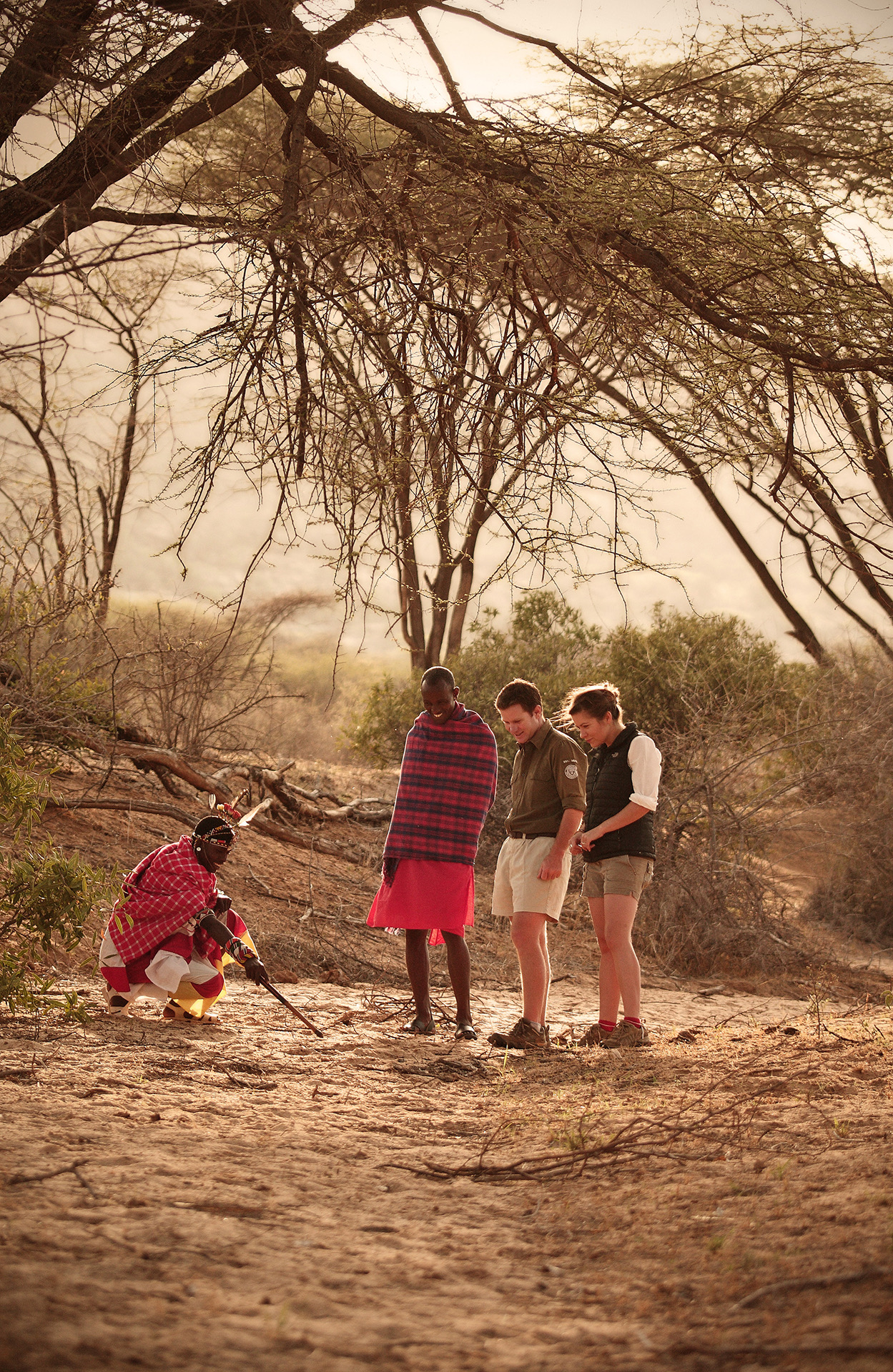
Walking changes the scale of everything. It is also the only activity here that is genuinely improved by there being nothing much to see.
Vehicle caps are the row people underestimate. A cap is not a courtesy; it is a number in a contract with somebody employed to enforce it, and it is the difference between a sighting and a car park.
Riding is rare, largely Laikipian, and one of the few ways to get close to plains game without an engine.
Fly camping — one or two nights in a light camp away from the main one — is the cheapest way to make an experienced traveller’s trip feel new.
What the permissions cost
Exclusivity prices exactly as you would expect. Land with a cap on it costs more per night than land without one, because somebody is being paid not to fill it.
| Per person per night | What it buys |
|---|---|
| US$800 – 1,200 | Established camps in genuinely good locations, a private vehicle throughout, light-aircraft hops between parks rather than long road transfers, and guiding that is a profession rather than a job. The entry point to a safari that does not compromise. |
| US$1,200 – 1,800 | Camps on private land, where the rules change: off-road driving to a sighting, night drives, walking with an armed guide, and a cap on how many vehicles may attend anything. Usually the point at which people stop comparing safaris on price. |
| US$1,800 – 2,500 | The camps people name when they get home. Six to ten tents, an owner or manager who is present, a guide assigned to you for the stay, and food that would hold its own in a city. |
| US$2,500 – 4,000 | A guide who travels with you from park to park rather than being handed over at each one, private charters on your own schedule, and small camps taken whole for your party. |
| US$4,000 and up | Exclusive-use houses and villas with their own staff, mobile expedition camps built for your route, and private aircraft between countries. Bought for privacy and control rather than for thread count. |
Indicative planning ranges only, per person per night sharing, for a fully inclusive safari — accommodation, meals, park and conservancy fees, guiding, and transport between parks. They are what we see in the market, not a quote and not an official tariff. Your quote will be exact and itemised. International flights are not included.
The split that usually wins
A week divided between a park or reserve and a conservancy tends to beat a week entirely on either. The public land gives you the set pieces and the numbers; the leased land gives you the mornings you will describe afterwards.
Where a trip is short — five or six nights — the split stops working, because the move eats a day. Then it is one place, properly, and the conservancy usually wins.
Ready to turn this into a real itinerary?
Send us your dates, who is travelling and roughly what you want to spend per person per night. Our East Africa specialist comes back within 24 hours with a plan built around them and a costed quote.